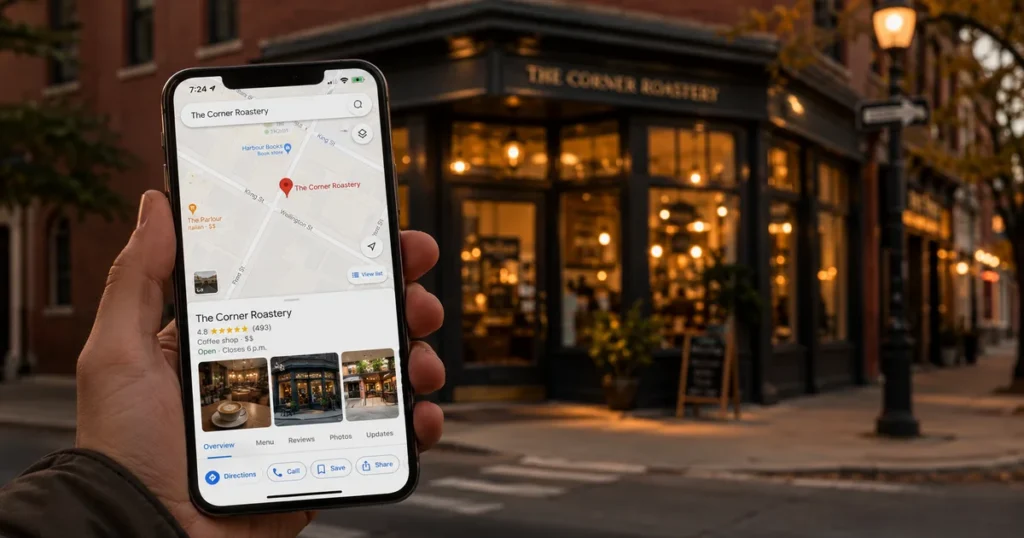
Your Google Business Profile is no longer just a map listing. It is the primary data source Google uses to decide whether your business appears in local results, in the map pack, and increasingly in AI-generated answers when someone asks for the best plumber nearby or a dentist open right now.
That last part is the change that matters. Search is now AI-assisted at serious scale. Google reported in May 2026 that AI Mode has passed one billion monthly users, and AI Overviews answer many local questions directly, often naming only a handful of businesses instead of showing a full results page. When those AI experiences answer a local question, they draw on structured business data, and your Google Business Profile is the most authoritative structured record of your business that Google holds. A complete, accurate, actively managed profile improves your visibility in classic local search and in AI-assisted discovery at the same time. An incomplete one quietly removes you from both.
These are the 11 profile fields that influence how you rank and how you show up, with the practical standard for each.
1. Business Name
Your business name is one of the strongest signals in local ranking, and the most commonly abused. Stuffing keywords into the name field violates Google’s guidelines and risks suspension, which costs far more visibility than the keywords ever added.
Get it right: Use your real-world business name exactly as customers know it. Consistency between your profile name, your signage, and your website also helps AI systems confirm they are describing the same business.
2. Address
Proximity is a core local ranking factor. Where your business sits relative to the searcher heavily influences whether you appear in the map pack, and businesses outside the city boundary they want to rank in face a structural disadvantage.
Get it right: Keep the address exact and consistent everywhere your business is listed. Service-area businesses that do not serve customers on site should hide the street address and define service areas honestly. Inconsistent addresses across the web are a trust problem for both rankings and AI answers.
3. Categories
Your primary category tells Google what your business fundamentally is, and it is one of the most decisive fields on the entire profile. Secondary categories extend your relevance to related searches. Local SEO industry surveys, including Whitespark’s 2026 local ranking factors report, consistently place the primary category among the heaviest profile-level signals, and a wrong primary category is one of the most common reasons a business underperforms locally.
Get it right: Choose the most specific primary category available, not the broadest. Review categories a few times a year, and check what categories the businesses outranking you use. When AI systems answer what kind of business this is, the category field is much of the answer.
4. Website Link
Google evaluates the website your profile links to. A relevant, fast, well-structured site strengthens the profile; a weak site limits it. The two rank together, not separately.
Get it right: Link to a site or location page that matches the profile’s name, address, and services, loads quickly, and answers the questions buyers actually ask. Structured, answer-first website content also feeds the same AI systems that summarize your business for searchers. This is where AI search visibility work and local visibility work reinforce each other.
5. Hours
Open-now status influences local results, especially for urgent, high-intent searches. A business marked closed during a search effectively concedes those queries to competitors, and wrong hours produce the worst outcome in local: a customer who showed up and found the doors locked.
Get it right: Keep regular hours accurate, set special hours for holidays, and compare your hours against local competitors. If demand exists outside their hours and you can serve it, your profile will be one of the few eligible to answer. This field is also taking on a new job: Google is rolling out agentic features in the U.S. that can book services and even call businesses on a customer’s behalf, so wrong hours or contact data no longer just misleads a reader. It can break an automated booking.
6. Reviews
Reviews influence rankings, conversions, and how AI systems characterize your business. Volume, average rating, recency, and the actual words customers use all matter. Review text is one of the places AI-generated summaries pull descriptive language from, which means your customers are partly writing your reputation in the AI era.
Get it right: Ask for reviews consistently as part of how you finish work, respond to all of them, and never buy or fake them. A steady flow of recent, detailed reviews outperforms a large but stale review count. Google now provides a shareable review link and QR code inside the profile dashboard, which makes the ask easy to build into checkout, invoices, and follow-up.
7. Attributes
Attributes like wheelchair accessible, women-owned, or outdoor seating sharpen relevance for specific searches and give both searchers and AI assistants concrete, filterable facts about your business.
Get it right: Review every attribute available for your business type and select all that truthfully apply. Attributes are free precision. As conversational queries get more specific, they decide whether you are in the answer set.
8. Services
The services field lets you define exactly what you offer, in the language customers search with. It helps Google match your profile to service-specific queries instead of only category-level ones.
Get it right: List every real service, named the way customers describe it. Add descriptions where Google allows them. A profile that says what you do in specifics consistently beats one that relies on a category alone.
9. Products
For retail and product businesses, the products section puts inventory directly into search results and gives Google another structured layer of what you sell.
Get it right: Keep product listings current with names, photos, and prices. Tools like Google Merchant Center can sync inventory. Products that are visible in your profile can win a customer before they ever reach your website.
10. Popular Times
Activity data plays a role in how Google understands your business, and local search practitioners have observed that busier periods correlate with stronger visibility during those windows. Whatever its exact ranking weight, the underlying signal is real-world engagement, which you can influence.
Get it right: Drive genuine visits and engagement: events, promotions during slower windows, and a reason for customers to check in digitally or physically. Engagement signals compound over time, and practitioners consistently report that visibly active profiles, with fresh photos and periodic updates, hold their visibility better than dormant ones.
11. Menu Items
For restaurants and food businesses, menu data feeds dish-level searches and the AI answers built on top of them. Incomplete or outdated menus mean invisible dishes.
Get it right: Keep the menu complete, accurate, and current, including prices. Fix typos. Every named dish is a query you become eligible to answer.
Beyond the Profile: Your Listings Have to Agree With Each Other
Google cross-references your profile against your presence across the wider web: directories, maps services, social profiles, and data aggregators. When your name, address, phone number, and hours agree everywhere, confidence in your data rises. When they conflict, both rankings and AI answers get cautious.
This is tedious, ongoing work across dozens of platforms, which is why it is usually the first thing businesses let slip. Business listing services exist to keep that entire layer accurate and synchronized, so the profile you optimized is corroborated everywhere else.
Why This Is Now an AI Visibility Issue, Not Just a Rankings Issue
Every field above was worth optimizing when the goal was the map pack. The reason to treat this with new urgency is that the same structured data now feeds AI-assisted discovery: AI Overviews at the top of results, conversational answers in AI Mode, and agent-style experiences that research, compare, and even book on a customer’s behalf. These experiences compress many results into a few named businesses, and they corroborate what they say using sources well beyond your profile, from your website to review platforms.
In that environment, complete and consistent structured data is the price of being mentioned at all. We cover how businesses earn presence in AI-generated answers in more depth in AI Search Visibility for Businesses.
For Agencies: Delivering Local Visibility Under Your Own Brand
If you run an agency, every client with a physical location or service area needs this work, monthly and verifiably. Rocket Driver has supported agencies since 2011 as a white label partner, handling profile optimization, listings management, and local visibility delivery under your brand, with your agency owning the client relationship. See how the delivery model works at white label services.
The consultation is a direct conversation about your situation: where your local visibility stands today, which profile fields are costing you, and what managed listings would change.
Schedule a consultation to review how your business shows up across search and AI-assisted discovery. If you have a question first, contact us and we will answer it plainly.